
Having graduated in 1977 I had to move away from Cornwall to start my career in computer programming and eventually got a job just outside Windsor in a converted country house called New Lodge. I moved to a rented flat in Maidenhead next to the noisy main railway line in Brunel Road sharing it with a friend from university that had got a job in Maidenhead after graduating. My friend Kevin Wright was a good all round sportsman having represented Loughborough at basketball as well as being a useful cricketer. A work colleague Graham Daniels who played for Braywood Cricket Club asked him to have a game at the club and he went along and started playing for them. Braywood is a small hamlet between Windsor and Maidenhead with the nearest village being Fifield just having school, a few houses and a cricket club. It was just down the hill from my first office with where I had joined Datagraphix, an American company making micro fiche machines and I could see the sightscreens from my office window.
I went along to watch Kevin play a game one Saturday and naturally was asked if I played cricket. I hadn’t played much since school days and at University cricket was not high on the curriculum there unless you were a County standard cricketer and exams always limited playing cricket in the summer term. Cricket didn’t feature in the extensive intra mural sports competitions between the various halls and self catering accommodation as there was only one cricket ground used exclusively for the University 1st XI.
As Braywood 2nd XI were always looking for new players at the time I agreed to play and had to get various items of cricket gear sent up from Cornwall in order to make my debut in club cricket.
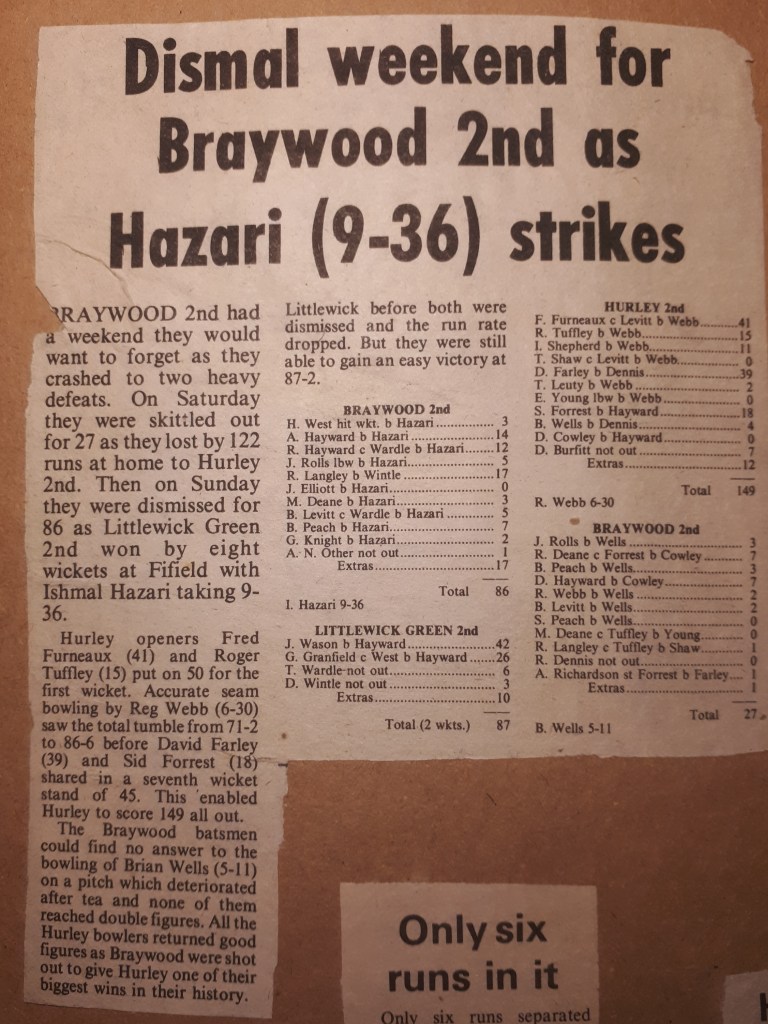
So on Saturday July 15th, 1978 I turned up for my first game under the captaincy of Richard Hayward who asked me what I did and he said I would probably get a bowl if possible and bat at 10 or 11. We took the field against Hurley 2nd XI and they had recovered from 86-6 due to accurate bowling from Braywood legend Reg Webb nearing the end of his long service to the club and had reached 131-6 lead by Hurley stalwart David Farley. Richard handed me the ball and said “Here you are chap, have a go and see what you can do”. I came off the two or three paces that constituted my ‘run’ up and delivered a well tossed up delivery. It dipped towards the end of its flight running out of forward momentum and sneaked its way past his intended cover drive to the fence going between bat and pad gently knocking back his middle stump dislodging the bails on its way. A long and happy time with Braywood CC had begun in the best possible way and the sixth ball of the same over was heading down past the batsman’s legs when it must have hit something to divert it back onto the leg stump. My first over in club cricket had produced 2 wickets and a 4 in between and the joys of being part of a team and club had commenced. I had two more overs that went for 10 runs before being asked to ‘take a blow’ by Richard who brought himself back on to mop up the tail, a captain’s privilege. The batting then suffered a fairly typical collapse to 27 all out with my contribution being 0* at No 10. I played a further 10 games that season with another 5 for the 2nd XI and 5 for the 1st XI where I was in demand as a keen fielder. I only bowled another 12 overs in total for the 2nd XI that season just taking two further wickets.
One other highlight of my first season in club cricket for Braywood was actually making a contribution with the bat for the first time in a 1st XI fixture at Little Kingshill CC. Replying to 200-3 dec at tea I was promoted to bat at No 6 which showed some faith as my highest score up to then was 5*. My batting ‘technique’ was developed from playing hockey where you had a much smaller piece of wood with which to stop the ball on much poorer surfaces than most cricket pitches. I would get everything behind the ball as in hockey with the bat in front and I had a good eye so would be able to survive for a long time with a limited range of scoring shots. Our club umpire Derek Carlton said he always had his forefinger poised when I was facing as I had everything in front of the stumps and only had to miss a straight one and he would be raising it. The angled bat down to third man was a profitable scoring area and I was very quick between the wickets so could just stop it and run with a willing partner at the other end. I once batted with one of our talented youngsters Simon Fogg who was very quick between the wickets and we ran the opposition ragged by just stopping it in front of us and running scoring 5 or 6 an over without hitting the ball more than a yard.
In the fixture at the very picturesque Little Kingshill ground in the Chilterns I came in at 6 to join my colleague Stuart West who had just had a good stand with my namesake Lindsey Dennis a quick bowler and hard hitting batsman in complete contrast to me. We were still on track to get to the 201 we needed to pull off an unlikely victory and I managed to stay with Stuart to put on another 40odd runs before being out bowled for 17. Brett Levitt at No 7 and skipper Graham Daniels at No 8 managed to stay with Stuart before Stuart got out for 60. Graham with his somewhat eccentric but effective batting technique which involved working virtually every delivery backward of square on the leg side was joined by club stalwart and another Braywood legend Jack Elliot who had actually been to Braywood school and lived in the hamlet most of his life. Jack was a veteran of many Braywood rearguard actions and held out for 5* whilst Graham got the required runs at the other end to finish on 27* and get us home by 3 wickets, a famous victory. In those days Braywood didn’t play any league cricket so every game was just as important as another with the exception of the local derby with Holyport.
A club cricket ‘career’ had started and I had a full season the next year with 26 appearances. Another novelty was to see the full scorecards reproduced in the Maidenhead Advertiser the following Thursday even if they got your initial wrong and luckily I still have the cutting of that game still in my scrapbook. It was certainly a week-end I’ll never forget.
1979 Season
My first full season of club cricket for Braywood was a period where the club struggled to raise a 2nd XI that could at least compete in all our fixtures. Being a small hamlet in the countryside recruitment of players was always going to be a challenge and they relied on the same method through which I had been recruited. The players had to get their own friends, work colleagues and in my case fellow hockey club members to come and play at Braywood rather than the many other clubs in Windsor and Maidenhead area at the time. Windsor Hockey Club was quite a rich vein of player recruitment with myself Stuart West and Neil Jamieson already playing there during the winter months. The hockey actually took place on the outfields of Windsor Victoria Cricket Club’s two cricket pitches in the vast area of Home Park in Windsor. I can remember persuading Dave Wallis, Dave Hope and Rory McCormack to become Braywood regulars via that route and get a few appearances out of Stuart Shepherd, Dave Felstead, Jim Stafford, Steve Wilson and quite a few others over the years.
I played about half and half for the 1st XI and 2nd XI and in general the Saturday teams were usually short of players as we had fixtures on both days of the week-end throughout the season from April until the end of September. I would often play for the 1st XI on Saturday and the 2nd XI on the Sunday that season. The 2nd XI were very short of batting that year which meant some low scores and quite a few rearguard actions to secure unlikely draws as all the games were time games in those days. I remember once batting out most of the last 15 overs with Paul Martin who was about 14 at the time to secure an honourable draw with Pinkneys Green 2nd XI with Braywood finishing on 57-9. So bare was our cupboard of batsman I actually finished that season by winning the 2nd XI batting cup. I have a trophy that proudly says 1979 C Dennis 144 runs on it. On seeing that trophy which is consigned to the loft these days people would say what a good innings that was. It rather spoils the kudos of winning a batting trophy when I explain that was my season’s aggregate! I only passed 20 twice that season with a career best of 36 v local rivals White Waltham 2nd XI who I enjoyed a modicum of success against over the years getting 5-29 in the same match which we actually won by scoring 186-4 with my new recruit Dave Wallis scoring 70.
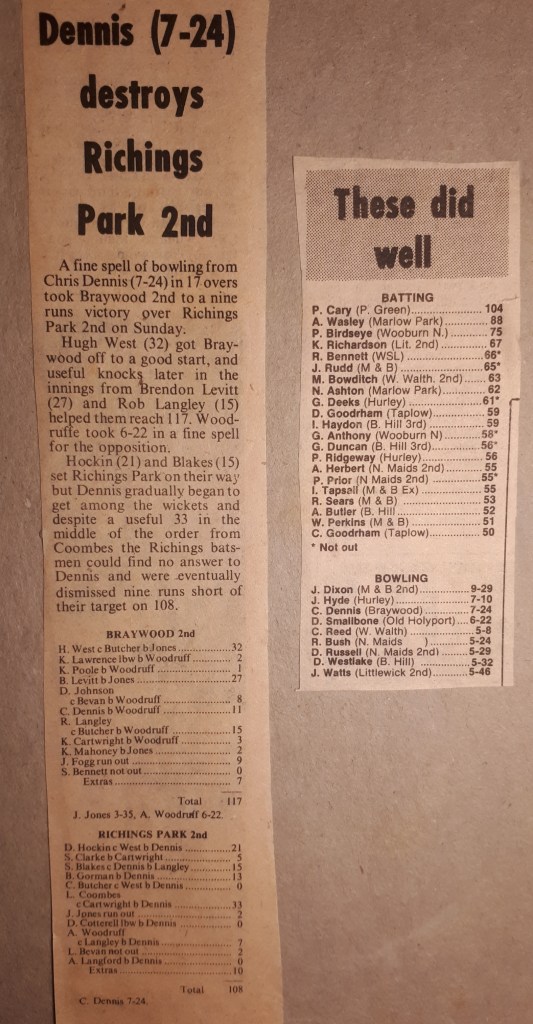
This season was to be the one I came into my own as a bowler and after an unpromising month in May a defining moment came in the 2nd XI away fixture at Richings Park 2nd XI in a leafy suburb of Slough. My captain that day was Hugh West one of the club’s senior players who had given great service to the club over many years including fathering two players and – as Cyril Martin would put it – a tea lady. His sons Stuart and Phillip were both in the tranche of youth players that came through in that era when sons of players were the main source of young players. Hugh’s daughter Karen was also to contribute greatly to the club by marrying a cricketer herself and recruiting Kevin Mahoney to the club another person to contribute greatly both on and off the field for the club. Kevin played one of his first games for the club that day under his future father-in-law’s captaincy.
Hugh West was a solid batsman and opened the inning that day at Richings Park and top scored with 32 in our modest total of 117. After opening the bowling with the strapping if not always accurate Kevin Cartwright and the more accurate and steady Rob Langley the former removed Park’s opener for 5 before the home side reached 40-1. Hugh probably thought there was nothing to lose at this stage and we would have to bowl them out to win and turned to me to replace Kevin Cartwright. Rob Langley then dismissed their number 3 before I got amongst the wickets when Hugh took two catches and one was bowled. I don’t recall the exact way it all unfolded after that but the Richings Park batsmen had probably not faced bowling like mine tossed up high and several holed out in the cow corner region. Other dismissals were probably playing back to balls that due to their lack of pace probably didn’t bounce too much or were tail enders having a big heave ho and playing well before the ball arrived. A middle order batsman started getting after the bowling and was caught by Kevin Cartwright having one too many slogs when victory for the home side was in sight. The tail didn’t contribute much and the last three wickets soon fell leaving them 9 runs short of victory and me with the figures of 17.5-8-24-7 which was to remain my best bowling figures for the rest of my playing days over 40 years. I had made my mark at the club and despite never hitting the heights again that season taking only 19 wickets in total for the 2nd XI in 11 games I secured the bowling cup as well mainly down to my average helped considerably on that day. A youngster made his debut that day getting 0* at No 11 and subsequently went on to become another great Braywood stalwart on and off the field. Steve ‘Ben, Kipper’ Bennett is still the club treasurer today and developed into a master practitioner of ‘in duckers’ before they were referred to as reverse swing and the upper cut over cover point well before it became fashionable in todays T20. It is remarkable how the many years of club service were spanned in that particular game from Hugh West starting at the club to today, probably a large percentage of the club’s 100 year history.
Although cricket is a team game individual performances can be the focus on occasions which is not always a good thing but every dog has he day I suppose. My main recollection of probably the best performance in a game v White Waltham 2nds again was of disappointment that we had lost the game against our great rivals. I took 7 wickets (which I only ever did 3 times) and scored 46 in that game but winning the game was the important thing that day. If you’re not an opening bowler or opening batsman you need them to fail essentially in order to get a big score or take a big haul of wickets. Stats are an interesting part of the game or people like me wouldn’t keep them. The player that often gets a quick 20 to get his side home or takes a blinding catch on the fence to get rid of the opponents top player doesn’t get often get their equally important contributions to their teams successes recognised when the prizes are handed out at the end of the season. The irony of the game is that the bowler that bowls a rank long hop or waist high full toss which is caught at full length just before heading over the boundary gets the main credit for such dismissals. I’ve profited many times from those type of deliveries as do bowlers even at test level but have at least been the one throwing their wicket away in a chase and taking catches in the deep to redress the balance. Rubbish does take wickets and good balls don’t but it adds to the changing room banter which is such an important part of a game we all take too seriously at times.
1980 Season
This season marked my first of 37 cricket tours being an early season overseas one in mid May to the Isle of Wight. We stayed at Warners Holiday Camp in Puckpool just outside Ryde which was an ideal venue for a cricket tour even having it’s own cricket ground. Accommodation in early season and drinks were cheap and other touring sides stayed there at the same time so you could play against each other as an extra fixture. The traditional tour opening fixture on the Isle of Wight was on a Sunday against Island Bakeries CC in Newport which was the perfect opening game for a tour not least because of the excellent teas. We usually managed to win that game and not many more as they were not a strong club side like most of the other fixtures. On that occasion I benefitted from a later introduction to the attack against their tail and picked up 5-22 which was one of only 3 times on 37 tours that I managed a ‘Michelle’ the others being for Bugle Hoot Toots CC v St Martins Isles of Scilly CC (population 136) and Washington v Petty Sessions Justice XI (Sydney). The other games were a rude awakening to a much higher standard of club cricket. Against Guildford City CC our fellow tourists staying at Puckpool I was hit to all parts of the holiday camp ground returning 1-71 in their 245-3 total. Their non bowlers gave us a game allowing us to reach 195-6 in reply. The next day we travelled down the East side of the Island to Ventnor to face their club side. This was an evening fixture as they only got 130 in their allotted overs with my contribution to their score being 0-20 off 3 overs, not bad in todays T20 terms but alot in those days. They had a tall man by the name of Jeff Hose playing for them whose son Adam has played for Somerset and Warwickshire in recent times. Adam is a hard hitting batsman in the mould of his dad who could give it a fair tap with his long reach. When we arrived at the ground we saw the former quarry shaped into a cricket ground with a flat middle and steep bits by the boundaries and very high walls at the top of the old quarry edge. “I bet no one has hit a ball over that wall” remarked Rob Langley on seeing the ground and he would have lost that bet after Jeff Hose had faced my flighted deliveries. It had been done before but it was one of the biggest hits ever seen on that ground at the time recalling Mike Llewellyn in the 1977 Gillette Cup final at Lords one of the biggest on that ground. We didn’t get near their total in reply that day and were fairly heavily beaten at Newport the next day on the old county ground that Hampshire had used on occasions. In those last 3 games I had taken 2-143 which was an introduction to a higher level of cricket for me. On the final day of the tour we teamed up with our vanquishers Guildford City to take on another touring party Hawker who looked like their emphasis had been on the party side of touring and had taken it’s toll by then and were dismissed for 80 allowing me to mop up a very jaded tail taking 4-16. The runs were duly knocked off allowing more time in the Newmarket Bar on site which had become a second home for some of the tourists particularly Cyril Martin and family. Some of us were a bit more adventurous in the evenings venturing forth along the promenade into Ryde to seek out the local beverage Burts and other delights that such a seaside resort might have to offer. On the day of the Ventnor game we managed to play golf at Ryde Golf Club using hired clubs and cricket boots as golf shoes. We nearly lost one of our players that day, our hard hitting batsman Neil Jamieson who has co-incidentally moved to the Island in recent years. The teeing areas were marked out by solid concrete pyramids with the face square onto the hitting area. Neil wound up for a big hit on the 4th tee as with his batting in which he would attempt to clear any boundary in his sights and quite often achieve it. He just made contact with the top of the ball sending it just off the ground heading straight for the ladies pyramidal tee marker only a few yards ahead. The ball hit the face of the pyramid that was facing straight back at Neil and began its return journey in that direction at about head height. The ball luckily had enough elevation to clear his shoulder blade but just avoid his head and continued its journey deep into a farmers field behind the tee never to be seen again. A close shave there which caused great hilarity and ammunition for the day’s fines chairman but could have reduced our party and top order batting had it taken a slightly different path that day.

The rest of the 1980 season was an unremarkable one on the field of play but it was the season I made my debut for Redruth CC being persuaded to join their tour in Wales that season. That tour is described in the Redruth section elsewhere and was the first of 9 consecutive tours to the principality with them. I couldn’t repeat my success against Richings Park 2nd XI from the previous season with 0-36 this time in a game where we hung on to draw with 77-9 replying to their 168-9. In fact showing the game’s capacity as a great leveller I had 0-46 the next season and never took another wicket against them as the fixture lapsed once we joined the league.
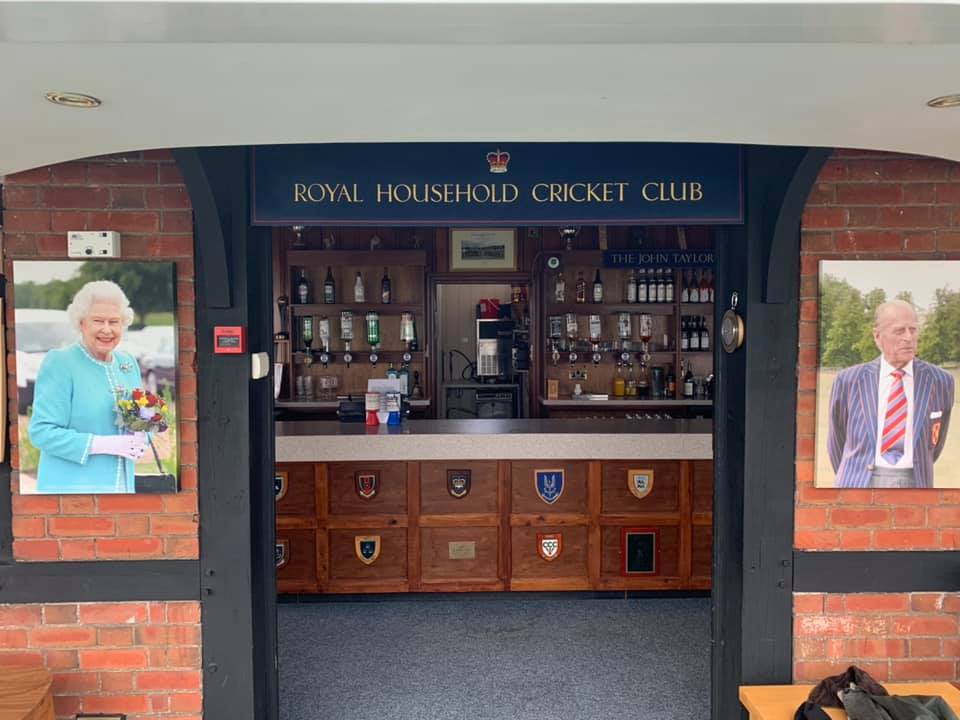
We continued to play non league cricket at Braywood although some leagues were forming in the area. We could still have a full Saturday and Sunday fixture list for both XIs so didn’t see the necessity to join a league at that point. Such fixtures as Wooburn Narkovians, Oxford Erratics and Eton Cavaliers were in the calendar and we wanted to keep them. We also played against The Royal Household CC within the grounds of Windsor Castle where you needed tight security to get in but once inside it was a tranquil setting away from the public bustle in Windsor. They are I believe the only cricket club permitted to have the royal crest on their badge and the ties were a sought after commodity. D. O. Edinburgh had turned out for them in the past as had Edward VIII (then Prince Edward) in 1905 in a match v Eton College which had amongst it’s number George VI (then Prince Albert).
The Royal Household had a fast bowler called Kevin Cattle who was in charge of the fire engine which was kept on site. He once told me it was the easiest job you could have as there were never any fires and he could play cricket to his heart’s content. He was to have a busy day in 1992 although not during the cricket season fortunately being in November when the catastrophic fire broke out in the castle. He would probably thought someone was winding him up during a game in order to get him away from the attack being a useful bowler and carried on regardless.
1981 Season
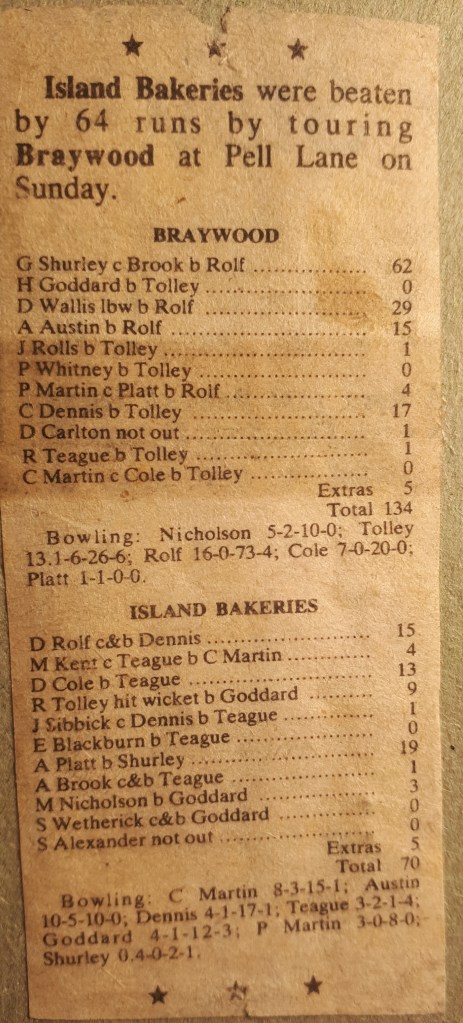
The 1981 season opened with a 2nd tour to the Isle of Wight on which I invited a couple of friends from Cornwall to come along Bob Teague as a player and Kim Launder as a supporter. Bob made his mark immediately in the traditional opening fixture against Island Bakeries in Ryde taking a catch of the bowling of Cyril Martin. He was then invited to bowl by captain Harry Goddard and proceeded to remove the next four Bakeries batsmen in three overs. A couple of deliveries kept rather low after landing and were labelled as ‘worm stunners’ by his Braywood team mates and he would always be remembered as the Worm Stunner from then on. Having taken 4 wickets for 1 run employing this type of delivery probably only for one of the dismissals as two were caught he was taken out of the attack by Harry denying him a chance for a 5 fer on his Braywood debut. Harry was probably mindful that there were greater challenges to come on the tour and this was a chance to use some bowlers that might not be employed in subsequent tour games including himself and Paul Martin. The Bakeries innings was wrapped up by Geoff Shurley who very rarely got to turn his arm over.
The next day was washed out and it gave an opportunity for myself Bob and Kim to visit most of the hostelries in the National Good Beer Guide on our side of the Island with Harry generously offering to drive us around not being a big drinker himself. On the next day a shortened game at Ryde after the rain saw Braywood only muster 79-9 in their 20 overs which Ryde managed to get although losing 7 wickets in damp conditions. the final tour match was a return to the bowl at Ventnor where the home side made 121 off 20 overs before rain returned and Braywood got an honourable draw being 10-1 when it was called off.

The rest of the 1981 season in which I played 37 games was one of a few highlights in terms of my own performances. I played 20 games for the 1st team that season probably more do do with my fielding than batting or bowling. I would rarely take more than 1 or 2 wickets when I bowled or score more than double figures when I batted.
The club captain that year was Cyril Knight a position he had held for many years at Braywood with other separate team captains for both Saturday and Sunday XIs. Cyril did a huge amount for the club over many years being involved with the building of the pavillion and in that year a new shed was built to house the ground equipment.
Towards the end of the season he captained a game on the field against The Fiddlers a wandering side from the Slough area. Braywood got a good total by tea thanks in the main to Cyril himself and Dave ‘Dinger’ Bellworthy both being prodigious run scorers for the club for many years. Cyril probably thought I hadn’t bowled much that season and proceeded to give me a long spell with plenty of runs to play with. In order to get a win in those days of time cricket you had to bowl the other side out which would often involve keeping them interested in the total by employing slow bowlers to toss of few up and keep them going for the runs. In this game it nearly worked as in an 18 over spell I took 5 for 70 and an exciting finish resulted with The Fiddlers falling just short but Braywood unable to claim the last wicket.
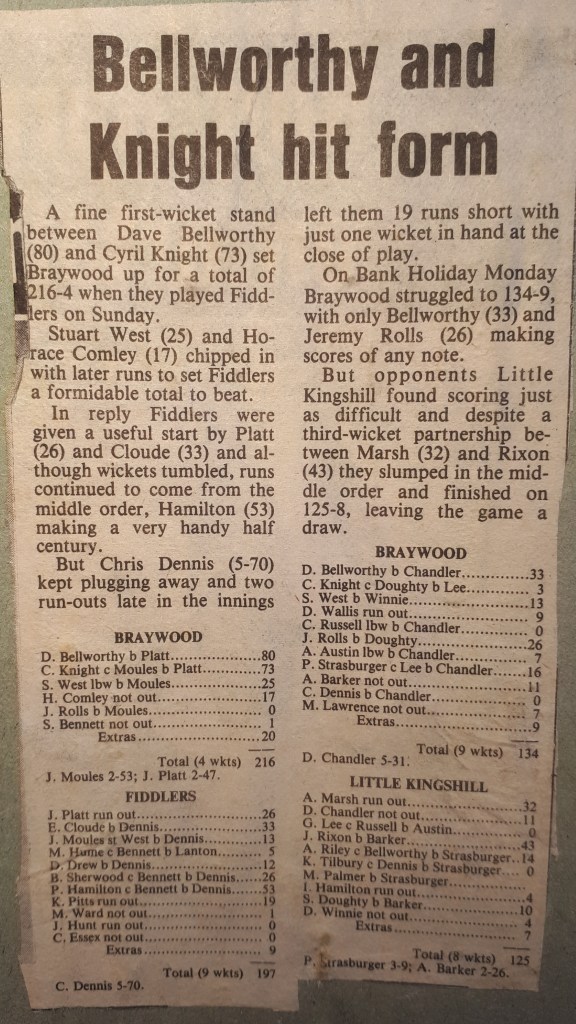
My cricket education was progressing having played three full seasons at Braywood and the importance of your captain as a slow bowler and knowing when to bowl you was often brought home to me. I would probably made more progress under the captaincy of Cyril Knight had he been a regular captain at the time.
1982 Season
This year saw a change in job as I started working in Oxford and as it was too far to commute from the Maidehead area where I was living in a shared house I took lodgings in a house in Stanford-in-the-Vale near the Oxfordshire/Wiltshire border. It turned out that my landlady had been at the same school in Truro as my sister by pure co-incidence and another friend of hers who played cricket lived in the area. As a result I started playing Sunday cricket for Letcombe CC in Letcombe and the odd Saturday for Challow and Childrey CC and a few games for Braywood as well. I made just 11 appearances for Braywood that season mostly at the beginning of the season. One of those was at Imber Court in Surrey one of our few excursions for games in the London area, I’m not sure how the fixture orginally came about probably through the cricet conference when both clubs were looking for a fixture. Imber Court was the home of the Metropolitan Police Sports Club and had great sporting facilities. The cricket square was renwoned to be one if not the biggest in the country allowing two games to take place on the same square without the boundaries overlapping. Our fixture was against the Imber Court local police team not the Met Police team who were a long way above our standard. I remember seeing Andrew Mack bowling quickly on the adjoining square once who had joined the Met after not quite making it in professional cricket at Surrey and then Glamorgan. The Imber Court tea were more of our standard being more like a club side drawing playser from their local area as wll as from the local police. We got an hourable draw that day hanging on at 108-8 as was often our wont when replying scores such as their 187-5. I made 0 that day my records tell me, one of many over the years, although it doesn’t record whether it was a first baller or not which I have also achieved on many occasions. As has been pointed out to me by my great school and Redruth CC friend Paul Berryman you can’t make 0 as you’ve already got 0 before you go out there.
I’ve seen an article recently where Sidmouth CC are going to implement a local rule for non-league matches at their seaside in ground in Devon where hitting a six to one side of the ground which endangers passers-by will now result in -5 from your score. This gives a few interesting possibilities for cricket statisticians and compilers of cricket conundrums such as both batsmen being 6 not out after 2 legitimate deliveries of an innings*. You could be out for -5 there now having hit one for six where you should not have done and then getting out. If a batsman reached a century and then in a moment of relaxation had a big heave ho at a subsequent delivery his score could then go back to 95 and he could then be out for less than 100 having reached that figure and raised his bat in recognition. If he then got back to 100 from 95 would he then raise the bat again? It will certainly add to the fines committees list of possible misdemeanours and is also open to some gamesmanship as well. If the scores were level in a limited overs game with one ball remaining a fielder under a high catch near that boundary might be tempted to palm it over the line for -5 to turn from a tie if he caught it or a loss if he dropped into a win by 5 runs.
*Two possible answers to the conundrum. 1st batsman runs 3 one short and there are 4 overthrows then 2nd batsman hits a 6. Or they run 7 one short – a less likely scenario.
1983 Season
This season marked the first time Braywood were to enter the leagues as the 1st and 2nd XIs entered the Berkshire Mercury League. It was getting more difficult to get Saturday fixtures locally as more and more teams were entering the leagues so the club decided it was time to join a league on Saturdays. The first league game I played in was for Braywood 2nd XI was at home to Theale 2nd XI and it turned out to be a successful entry into league cricket for me and the club. We had entered the league at a low level so had some winnable games such as this one against a new opponent. The league matches were 90 over matches with the side batting first able to take up to 47 overs leaving the side side the remainder of the overs. If you used up more than half of the overs and didn’t win you could only get a losing draw and 1 point for your afternoons efforts. A winning draw got you 3 points and a win 6 points which was a simple system with no batting or bowling points which depend largely on the quality of the wicket. We made a slow 121-9 in our allotted overs although I’m not sure if we carried on for 47 overs or not. There were no restrictions on bowlers in those days and our new 2nd XI league captain Kevin Mahoney decided we needed to attack and bowl them out to win as winning draw was unlikely. He opened the bowling with me and I proceeded to bowl one of my longest spells ever returning 19-6-30-5 as we bowled out them out for 60 to give us a winning 6 point start.
For slow bowlers there is a huge amount of confidence needed to propel the ball at a much lesser velocity than their fellow faster bowlers with much less margin for error. You only have to stray in length or line slightly for the batsman to despatch you unceremoniously into the adjoining cow fields which can also happen to your best deliveries of course. This only has to happen once or twice and you hear the dreaded words from your captain at the end of the over asking you to ‘have a blow’ or ‘take a rest’ thanking you for your contribution which has now ended for the day. I remember having my best ever return in a 1st XI league match and having sky high confidence going into the next game only to be told the ground was too small for me to be risked. You also need to bowl regularly as a week without bowling means you’ve gone two weeks before you’re asked to come on usually against two well set batsman both with over 50 each on the board on the ground that is used for county games as the wicket is so good. I was actually a far better bowler in my 60s than in my 20s and 30s as I had learned so much by then and actually developed a quicker bowling style when required so I could keep batsman quiet allowing me to be kept on. When a batsman was getting after me I actually enjoyed the challenge and was often kept on anyway for fear of using our young bowlers whose confidence could be shattered by being carted everywhere.
This long spell in my first league game augured well as I had a 14 over spell in the next league game against local rivals Pinkneys Green 2nd XI taking 4-44 in a winning draw. My next league game saw a breakthrough with the bat against Wraysbury 2nd XI scoring 34 out of our total of 133-7 a total they passed for 6 wickets none of which I took getting 0-20 in that game. Wraysbury’s ground lies directly under the flight path into Heathrow with huge planes making that very loud noise as the apply their air brakes and whatever else they do to halt the momentum of 300 tons of metal and humans before reaching a speed sufficient to allow a safe landing. This would make it difficult for umpires to hear snicks or even batsman hearing their partner let them know that a run would not be a judicial action at that particular moment. There was respite on days in which the Queen was in residence in Windsor as the turret of the castle was used for lining up to land at Heathrow before descending further over Wraysbury CCs ground. When I lived in Windsor you could see the next 3 or 4 planes lining up to take this route which also included my flat so on hot days in summer you had to chose whether the heat or the noise would keep you awake when deciding to open the window.
The next day we were playing the same opponents again as they were regular Sunday 2nd XI opponents and it happened to be the same week-end. With the confidence gained from the previous day I proceeded to record my highest score to that date of 48*. I couldn’t get to a maiden 50 as time had run out and we had enough runs to declare at tea time but it was a defining moment as I was seemingly emerging as a useful 2nd XI batsman giving afternoons more than one avenue of pleasure as John Cleese would put it.
When you think you’ve cracked something in cricket though the game is quick to remind you that you haven’t as was shown by my next run of scores which were 0, 1, 0, 1*, 4, and 0.
I only had 3 more scores in double figures that season so had developed a technique that only seemed to work against Wraysbury with 22* v Frimley 2nd XI being the best of the rest that season.
1983 was first Braywood tour of Cornwall which was to continue for a further 19 years after that. With my contacts at Redruth CC it seemed a good alternative to the Isle of Wight tour that had been losing interest. The tour was to be based at The Hollies Hotel in Redruth a short walk up the hill to Redruth CC and downhill all the way back when walking might become more onerous after a long day on and off the field at Trewirgie. Paul Berryman helped me get 4 fixtures against some of the top grounds in the West of Cornwall. As luck would have it the first game at the picturesque Perran-ar-Worthal ground was washed out as was the second game at Mount Ambrose. The cricket finally got under way at Redruth who were determined to get a game on however damp conditions might be underfoot. The game resulted in a win for the tourists with Redruth fielding a side picked for their prowess off the field rather than on it and were bowled out for 95 in reply to Braywood’s 185-4. A convivial evening ensued in the Redruth clubhouse with the tourist knowing it was only a short walk back leaving kit behind to be retrieved the next morning. The conviviality continued in The Hollies Hotel after returning there where host Adam Hood introduced the tourists to the delights of spoof and shut the box in which the evetual losers have to buy their fellow participants a drink.
1984 Season
This season saw Braywood 2nd XI in a tougher league than the year before. The leagues were restructured into The Lafford and Leavey Berkshire League and we faced some stronger teams in the Reading area as a result. Looking at the results of the games I played in for the 2nd XI there were only 3 victories against the 3rd XIs of Sonning and Kidmore End and our old rivals White Waltham 2nd XI. A total of just 19 wickets in 22 games for the 2nd XI indicated a much tougher set of opponents that year where wickets were harder to come by. Generally my figures were tidy at around 3 runs an over in most league games but not many wickets. At a higher level batsmen would actually treat a good ball with respect and generally milk a spinner keep them on without too much danger of being out. Playing against lesser batsmen you tend to get hit more off your better deliveries as they are within their hitting area. The cross batted swing over square leg can be hit with remarkable consistency by some batsman from a ball destined to hit middle half way up. In contrast a long hop or full toss would either be missed completely or send high in the air in the direction of point or short mid wicket.
 Fifty Five Years of Cricket Memories